go binary
12MB
Static Binary
A single statically linked Go binary. No JVM, no interpreter, no runtime to install alongside your validator.
A single static Go binary that polls your validator's JSON-RPC into Prometheus and flags degradation before it becomes on-chain delinquency. Self-hosted, with no external API fees.
The Solana Foundation Delegation Program is actively pruning underperforming nodes. Bad performance now equals immediate removal and loss of delegated stake. SentinelSOL was engineered to give operators a predictive edge, catching hardware degradation and network exhaustion before it results in on-chain delinquency and stake-stripping.
Relying on external third-party monitors means by the time an alert fires, you have already lost vote credits. Latency inherent to cloud-based polling puts your performance metrics behind reality by minutes, minutes that cost you.
Fires when: already delinquent
Vote credits lost: unrecoverable
SentinelSOL tracks vote-credit velocity from the validator's own JSON-RPC and fires when it sustains a drop of 3 standard deviations below the node's rolling one-hour baseline. No external API round-trips - the signal is polled and evaluated entirely on infrastructure you control.
Detection path: 10s poll → 10s scrape → 2m sustained
Degradation threshold: σ = 3.0
A single statically linked Go binary. No JVM, no interpreter, no runtime to install alongside your validator.
Polling your own RPC endpoint means no cloud bandwidth charges and no metered third-party data API in the collection path.
One docker-compose command deploys the Extractor, Prometheus, and Grafana. Fully wired, zero manual config.
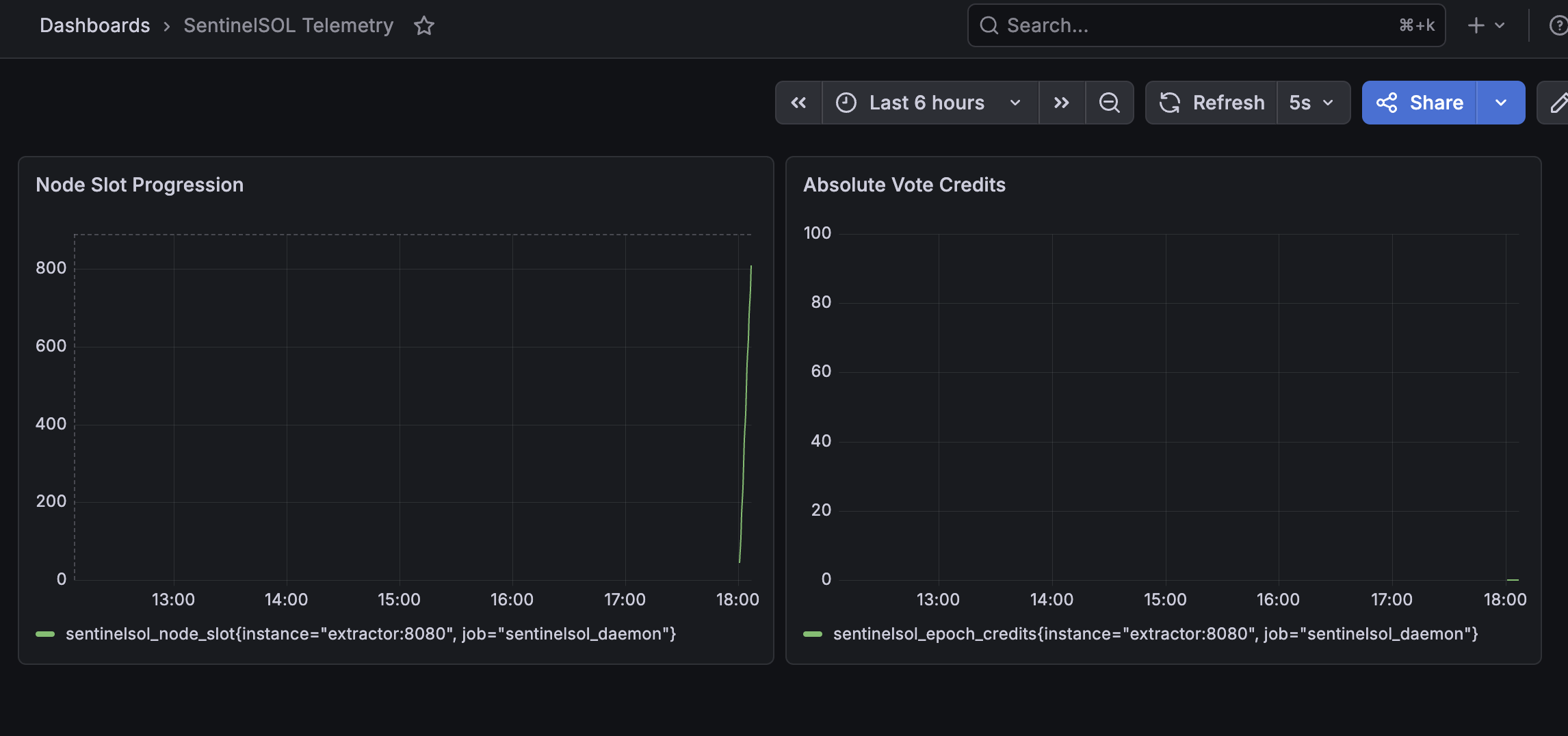
The extractor polls your validator's JSON-RPC every 10 seconds and exports vote-credit accrual and slot progression on a Prometheus endpoint. The 3-sigma Z-score runs in Prometheus itself as recording and alerting rules, so the Go binary stays a small, auditable collector you can read line-by-line.
1package main23import (4 "net/http"5 "time"6)78// httpClient is shared across all RPC polling goroutines.9// A single instance with a hard timeout prevents goroutine leaks10// under degraded network conditions.11var httpClient = &http.Client{12 Timeout: 5 * time.Second,13}Built by Hamza Shaikh - Site Reliability, DevOps and Cloud Infrastructure - with a second contributor. When analyzing the Solana ecosystem from a reliability perspective, a critical gap became apparent: existing validator observability is entirely reactive. SentinelSOL runs as a separate process from the validator, with a configurable RPC endpoint so it can be deployed on an isolated host. It polls the validator over Solana JSON-RPC for vote-credit accrual and slot progression, then applies 3-sigma Z-score anomaly detection over a rolling one-hour baseline to surface degradation before on-chain delinquency. Winner, Superteam Germany / neosfer Solana Ideathon, Frankfurt 2026; also submitted to the Colosseum Frontier hackathon.